Noah Graham
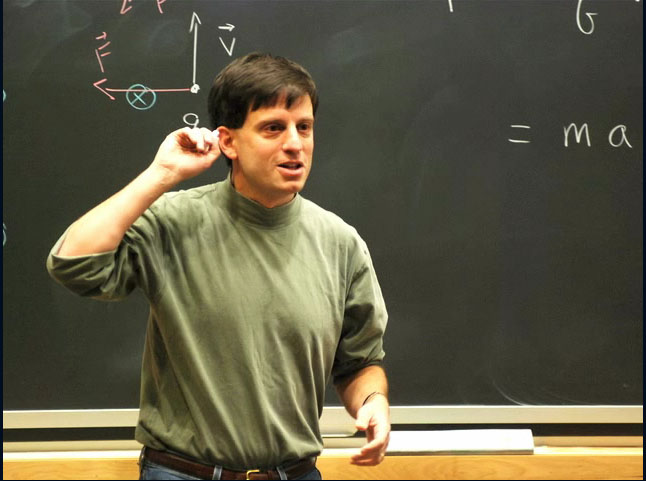
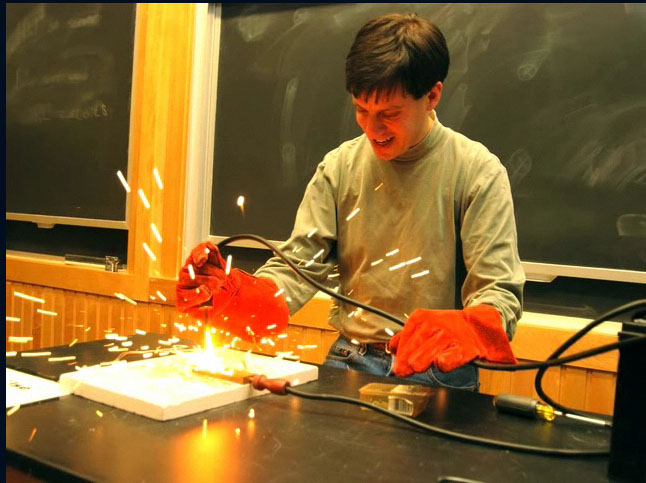
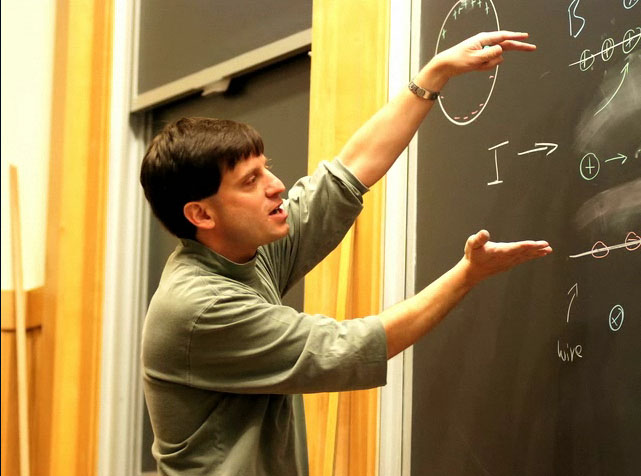
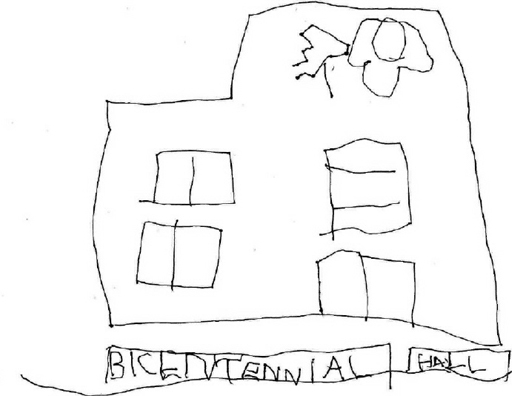 Drawing by Benjamin Graham, Photographs by Angela Evancie '10
Contact info:
Department of Physics
McCardell Bicentennial Hall
Middlebury College
Middlebury, VT 05753
(802) 443-3423
Fax: (802) 443-2072
ngraham [at] middlebury [dot] edu
Education:
- A. B., Physics and Mathematics, Harvard, 1994
- Ph. D., Physics, MIT, 1999
Talks/references:
Research:
My research centers around applications of quantum mechanics and classical
and quantum field theory to a variety of problems in elementary particle
physics, physics of solitons and oscillons, and the Casimir effect. I am
also interested in applications of physics techniques to applications in
computer science.
Here are some possible thesis topics on these
subjects, or you can
read my
fascinating papers.
I gratefully acknowledge the
National Science Foundation,
Research
Corporation, Vermont EPSCoR, and
Middlebury College for grants supporting my research.
Spheroidal Functions in Mathematica®:
I have extensively modified the package of Falloon for
computing spheroidal wave functions in Mathematica®. The resulting
code is faster for common cases, adds series expressions around the
spherical limit for the radial functions, and fixes several bugs
(particularly in the series expansions); see the readme for details.
These changes were
developed with assistance from Pavlo
Levkiv.
Spheroidal package for Mathematica 4
Spheroidal package for Mathematica 5
Spheroidal package for Mathematica 6 and later
By downloading or using any of these packages you agree to the following
license terms, also which are also given in
the license file.
This package is based on previous work of Falloon (see P. E. Falloon, P. C.
Abbott, and J. B. Wang, J. Phys. A36 (2003) 5477), which does not
indicate any license restrictions or copyright. Modifications are copyright
© Noah Graham, 2005-2016, all rights reserved. The modified packages
may be used and modified for noncommercial research or educational purposes,
provided that citations to the previous work by Falloon et. al. listed
above and
T. Emig, N. Graham, R. L. Jaffe and M. Kardar,
"Casimir Manipulations: The Orientation Dependence of
Fluctuation-Induced Forces," arXiv:0811.1597,
Phys. Rev. D77 (2008) 025005
are included in all publications or other products in which the modified
package or any programs derived from it was used. Commercial use or
inclusion in a commercial product is prohibited. This program and all
accompanying materials are provided "AS IS," WITHOUT WARRANTY OF ANY KIND,
EITHER EXPRESSED OR IMPLIED, INCLUDING, BUT NOT LIMITED TO, THE IMPLIED
WARRANTIES OF MERCHANTABILITY AND FITNESS FOR A PARTICULAR PURPOSE.
Update: The package for Version 6 also appears to work in Version
7 (and later) as well. To use it with parallel computation, be sure
that the package is loaded in all subkernels. Although the performance
of the built-in spheroidal functions is considerably improved in Version 7,
the package here still is faster for many common cases and contains
additional functionality.
General-purpose Mathieu Function Routines in Mathematica®:
The following Mathematica® package improves on various limitations of
the built-in Mathieu functions. In particular, it supports both first- and
second-kind functions, as well as radial and modified functions, and is
reliable even for complex parameter and argument, as described in
this paper.
Original package written by Elizabeth Noelle Blose '17, Biswash Ghimire '16,
Noah Graham, and Jeremy Stratton-Smith '17. Updated July 2016 to include
code for series expansions around q=0 by Daniel Esrick '18 and Carrie Owen '18.
Further improvements and updates August 2021 by Hyuma Umeda '24.
Mathieu Function Package
By downloading or using this code you agree to the following license terms:
All contents are copyright © 2014-21, all rights reserved. These
programs may be used and modified for noncommercial research purposes, provided that citation to
Elizabeth Noelle Blose, Biswash Ghimire, Noah Graham, and Jeremy
Stratton-Smith, "Edge Corrections to Electromagnetic Casimir Energies From
General-Purpose Mathieu Function Routines," arXiv:1411.0734,
Phys. Rev. A 91, 012501 (2015)
is included in all publications or other products in which
the program or any programs derived from it were used. This program and
all accompanying materials are provided "AS IS," WITHOUT WARRANTY OF ANY
KIND, EITHER EXPRESSED OR IMPLIED, INCLUDING, BUT NOT LIMITED TO, THE
IMPLIED WARRANTIES OF MERCHANTABILITY AND FITNESS FOR A PARTICULAR PURPOSE.
Casimir Energy of a Disk:
English translation of Joseph Meixner, "A Rigorous Theory of the Diffraction of Electromagnetic Waves on a Perfectly Conducting Disk,"
Z. Naturforschung 3a, 506 (1948). English translation by Nimrod Sadeh '17.5; original paper here.
The following Mathematica® notebook implements the calculation of the Casimir energy for a disk-plane system,
as described in this paper.
Casimir energy of disk and plane
By downloading or using this code you agree to the following license terms:
All contents of these notebooks are copyright © Noah
Graham, 2016, all rights reserved. These programs may be used and modified
for noncommercial research purposes, provided that citation to
N. Graham, "Exact Electromagnetic Casimir Energy of a Disk Opposite a Plane," arXiv:1606.01090,
Phys. Rev. A 94, 032509 (2016)
is included in all publications or other products in which
the program or any programs derived from it were used. This program and
all accompanying materials are provided "AS IS," WITHOUT WARRANTY OF ANY
KIND, EITHER EXPRESSED OR IMPLIED, INCLUDING, BUT NOT LIMITED TO, THE
IMPLIED WARRANTIES OF MERCHANTABILITY AND FITNESS FOR A PARTICULAR PURPOSE.
Parallel C++ classical field theory simulation of electroweak SU(2)xU(1) model:
Here is some code that does a lattice
simulation of oscillons in the electroweak Standard Model, as shown in
this paper and
this paper. It includes
SU(2)xU(1) gauge fields and a fundamental Higgs field and allows for
parallel processing using MPI, threads, or both. It has been adapted
to a number of other situations, including SU(2) adjoint gauge fields,
abelian Higgs models, and expanding universe backgrounds -- please contact
me if you are interested in the details. By downloading or using this code
you agree to the following license terms:
All contents of this package are copyright © Noah Graham, 2006-2007, all
rights reserved. This program may be used and modified for noncommercial
research purposes, provided that citation to
N. Graham, hep-th/0610267, "An Electroweak Oscillon," Phys. Rev. Lett. 98 (2007) 101801
and/or
N. Graham, arXiv:0706.4125 [hep-th], "Numerical Simulation of an Electroweak Oscillon," Phys. Rev. D 76 (2007) 085017
is included in all publications or other products in which
the program or any programs derived from it were used. This program and
all accompanying materials are provided "AS IS," WITHOUT WARRANTY OF ANY
KIND, EITHER EXPRESSED OR IMPLIED, INCLUDING, BUT NOT LIMITED TO, THE
IMPLIED WARRANTIES OF MERCHANTABILITY AND FITNESS FOR A PARTICULAR PURPOSE.
Variable Phase S-Matrix Calculations for Asymmetric Potentials and Dielectrics:
The following Mathematica® notebooks implement the variable phase
method for potentials and dielectrics, as described in
this paper.
Variable phase calculation, scalar case
Variable phase calculation, vector Helmholtz case
Variable phase calculation, electromagnetic case
By downloading or using this code you agree to the following license
terms, which are also included in the packages themselves.
All contents of this notebook are copyright © Aden Forrow and Noah Graham, 2012, all rights reserved. These
programs may be used and modified for noncommercial research purposes, provided that citation to
A. Forrow and N. Graham, "Variable Phase S-Matrix Calculations for Asymmetric Potentials and Dielectrics," arXiv:1210.0777,
Phys. Rev. A 86 (2012) 062715
is included in all publications or other products in which
the program or any programs derived from it were used. This program and
all accompanying materials are provided "AS IS," WITHOUT WARRANTY OF ANY
KIND, EITHER EXPRESSED OR IMPLIED, INCLUDING, BUT NOT LIMITED TO, THE
IMPLIED WARRANTIES OF MERCHANTABILITY AND FITNESS FOR A PARTICULAR PURPOSE.
Variable Phase S-Matrix Calculations for Periodic Dielectric Gratings:
The following Mathematica® notebook implements the variable phase
method for dielectric gratings, as described in
this paper.
Variable phase calculation, electromagnetic case
By downloading or using this code you agree to the following license terms:
All contents of these notebooks are copyright © Noah
Graham, 2014, all rights reserved. These programs may be used and modified
for noncommercial research purposes, provided that citation to
N. Graham, "Casimir Energies of Periodic Dielectric Gratings," arXiv:1407.4642, Phys. Rev. A 90 (2014) 032507
is included in all publications or other products in which
the program or any programs derived from it were used. This program and
all accompanying materials are provided "AS IS," WITHOUT WARRANTY OF ANY
KIND, EITHER EXPRESSED OR IMPLIED, INCLUDING, BUT NOT LIMITED TO, THE
IMPLIED WARRANTIES OF MERCHANTABILITY AND FITNESS FOR A PARTICULAR PURPOSE.
Teaching:
Below are custom lecture notes I use for our upper-level undergraduate
courses in quantum mechanics (PHYS 0318) and statistical mechanics (PHYS 0350).
All of these materials are copyright © 2011-2024, Noah Graham. They
may be used for noncommercial purposes with proper attribution, including
this notice.
Quantum Mechanics Notes
Statistical Mechanics Notes
Below are lessons on quantum mechanics I have developed for the course
"Quantum Mechanics From a Linear Algebra Point of View." They assume
knowledge of linear algebra (at the level of Strang's book, for example)
and basic (high school or introductory college level)
familiarity with introductory mechanics and electromagnetism.
Rather than the usual wave-mechanics approach used in most textbooks
and quantum mechanics courses (such as our PHYS 0202 and PHYS 0401), they use the
more physically abstract but mathematically simpler picture of finite dimensional
matrices. My hope is they can provide a complement to standard
undergraduate quantum mechanics references such as Gasiorowicz, Griffiths,
and Liboff. This approach is also more directly applicable to problems in
quantum computing.
All of these materials are copyright © 2002-2010, Noah Graham. They
may be used for noncommercial purposes with proper attribution, including
this notice.
Lesson 1
Lesson 2
Lesson 3
Lesson 4
Lesson 5
Lesson 6
Lesson 7
Lesson 8
Here are slides from a talk introducing this approach,
aimed at an audience familiar with introductory linear algebra (no physics
background is assumed).
Having worked in industry
doing research in speech recognition, I am also interested in applications of
scientific computing, both to physics and to subjects like speech and vision.
(See also work by my brother,
Middlebury class of '01.)
Below are the first three projects from PH120, Computers in the Physical
Sciences. These are designed to provide introductions to the applications of an
object-oriented approach using Mathematica© and C++ to problems in the
physical sciences. Other examples of computational assignments from PH301,
Intermediate Electrodynamics, PH350, Statistical Mechanics,
and PH401, Quantum Mechanics, are below as well.
All of these materials are copyright © 2002-2007, Noah Graham. They
may be used for noncommercial purposes with proper attribution, including
this notice.
Project 1
Project 2
Project 3
PH301 Project
PH350 Project
PH401 Project
